

Most of us know the feeling of a long day catching up with us. For people with narcolepsy, the sleepiness is different. It is there every day, it is hard to fight, and it doesn't go away with more rest at night.
Here's a simple look at what narcolepsy is, how it's diagnosed, and how it's treated.
What is narcolepsy?
Narcolepsy is a long-term (chronic) condition that causes excessive daytime sleepiness. It's one of a group of disorders where the brain has trouble controlling sleep and wakefulness.
It's not common. About 20 to 67 people out of every 100,000 have it. It often begins in childhood or the teen years, with a smaller second peak around age 35. Sadly, many people go years before getting the right diagnosis.
Two types
Narcolepsy type 1 is linked to the loss of brain cells that make orexin (also called hypocretin), a chemical that helps keep us awake. This loss is most likely caused by the body's own immune system.
In narcolepsy type 2, orexin levels are normal, and the cause is still unknown.
What does it feel like?

For some people, strong emotions like laughter can trigger brief muscle weakness (cataplexy).
The main symptom is daytime sleepiness that is hard to resist. People often take short naps that leave them feeling refreshed, sometimes with dreams. Some have sudden "sleep attacks." Interestingly, the total amount of sleep usually isn't longer than normal.
Other symptoms can include:
Cataplexy: brief muscle weakness, lasting seconds up to about 2 minutes, set off by positive emotions like laughter or surprise. The person stays aware. It can be subtle, like a head drop, a sagging jaw, facial weakness, or knees buckling.
Hallucinations when falling asleep or waking up.
Sleep paralysis, a brief inability to move around sleep.
Broken-up nighttime sleep.
Some people also have weight gain, acting out dreams, leg movements during sleep, or mood-related conditions. A few notice mainly trouble sleeping at night.
How is it diagnosed?
A key requirement is daily, irresistible sleepiness for at least 3 months. From there, doctors combine a careful history with sleep testing. That usually means an overnight sleep study and a daytime nap test, which show how fast you fall asleep and how quickly dreaming (REM) sleep begins. In some cases, doctors measure orexin in the spinal fluid or run a genetic blood test.
How is it treated?
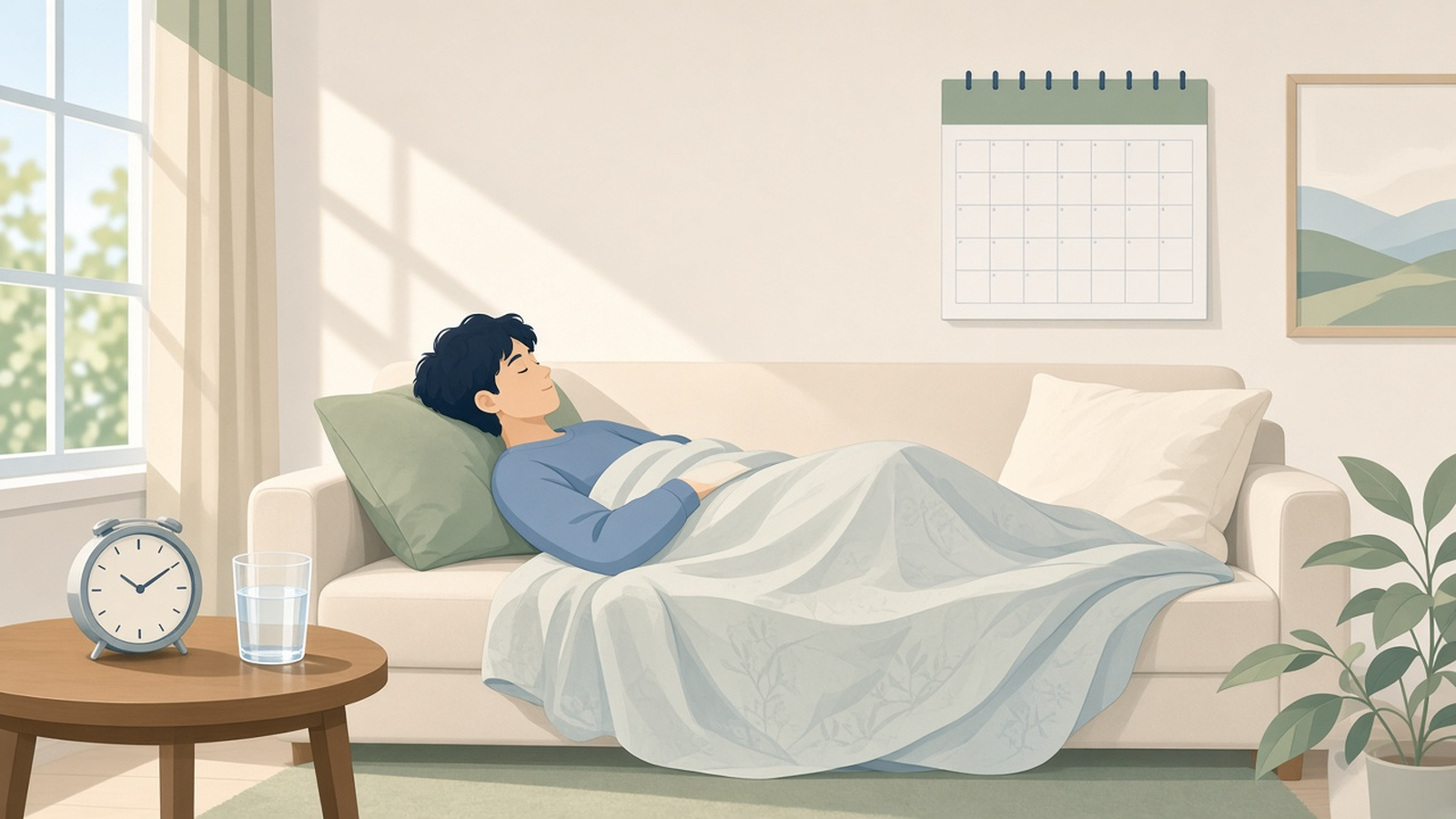
Short, planned naps and a regular schedule are a key part of treatment.
Treatment starts with daily habits:
Keeping a regular schedule with enough nighttime sleep
Planning one or two short naps (15 to 30 minutes) each day
Asking for flexibility at school or work, like nap breaks or extra time on tasks
Treating other sleep problems, such as sleep apnea
Not driving when drowsy, since people with narcolepsy have a higher crash risk
Medications can help too. Several are used to improve daytime alertness, including modafinil, armodafinil, solriamfetol, and pitolisant. When cataplexy is present, doctors may use oxybate medicines or pitolisant. Many people need more than one medicine, since current options give only partial relief.
A hopeful new step
In 2026, the FDA approved oveporexton for adults with narcolepsy type 1. It's the first treatment designed to target the orexin loss behind this type of narcolepsy. In an early study, it improved sleepiness and thinking and reduced cataplexy compared with placebo. Long-term data comparing it with other treatments are still limited.
You don't have to just push through
If you or someone you love is always sleepy, nods off unexpectedly, or has muscle weakness when laughing, it's worth paying attention. These symptoms are real, and help is available.
This article is for general education only. Please talk with your healthcare provider or a sleep specialist about your symptoms and the right next steps for you.
References
Maski KP, Scammell TE. Narcolepsy. JAMA. 2026. https://jamanetwork.com/journals/jama/fullarticle/10.1001/jama.2026.14685
FDA Orange Book. 2026. https://www.fda.gov/drugs/drug-approvals-and-databases/approved-drug-products-therapeutic-equivalence-evaluations-orange-book
Thorpy MJ. Recently Approved and Upcoming Treatments for Narcolepsy. CNS Drugs. 2020. https://doi.org/10.1007/s40263-019-00689-1
Biscarini F, et al. Use of Portable 24-Hour Polysomnography as Alternative Diagnostic Tool for Narcolepsy Type 1. Neurology. 2025. https://pubmed.ncbi.nlm.nih.gov/40080737
Pérez-Carbonell L, Mignot E, Leschziner G, Dauvilliers Y. Understanding and Approaching Excessive Daytime Sleepiness. Lancet. 2022. https://pubmed.ncbi.nlm.nih.gov/36115367
Mignot E, Yanagisawa M. The Orexin System—A Key Component of Sleep Regulatory Networks and Involvement in Narcolepsy: The 2026 Albert Lasker Basic Medical Research Award JAMA. 2026. https://jamanetwork.com/journals/jama/fullarticle/10.1001/jama.2026.15598
Maski K, Owens JA. Insomnia, Parasomnias, and Narcolepsy in Children. Lancet Neurol. 2016. https://pubmed.ncbi.nlm.nih.gov/27647645
Partinen M, et al. Narcolepsy as an Autoimmune Disease: The Role of H1N1 Infection and Vaccination. Lancet Neurol. 2014. https://pubmed.ncbi.nlm.nih.gov/24849861
Scammell TE. Narcolepsy. N Engl J Med. 2015. https://doi.org/10.1056/nejmra1500587
Lloyd RM, et al. Quality Measures for Care of Patients With Narcolepsy: 2025 Update. J Clin Sleep Med. 2025. https://doi.org/10.5664/jcsm.11834
Morse AM, et al. Narcolepsy: Beyond the Classic Pentad. CNS Drugs. 2025. https://doi.org/10.1007/s40263-024-01141-9
Dauvilliers Y, et al. Oral Orexin Receptor 2 Agonist in Narcolepsy Type 1. N Engl J Med. 2023. https://doi.org/10.1056/nejmoa2301940
Sources gathered with OpenEvidence.