
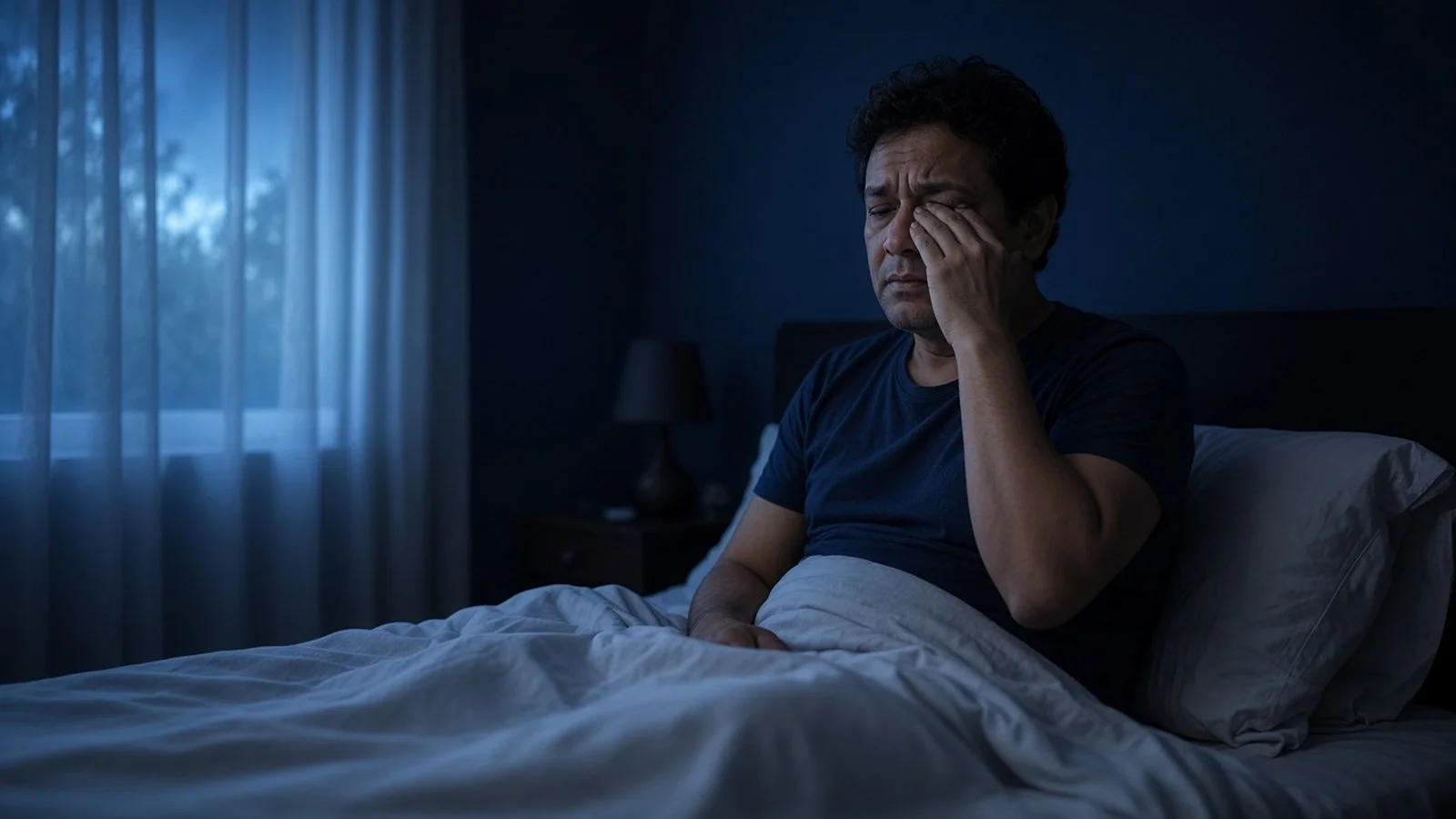
Your child sits up in bed screaming and doesn't seem to know you're there. Your partner walks into the kitchen at 2 a.m. and remembers nothing the next morning. Or the person next to you punches and kicks in their sleep, as if they are fighting someone off in a dream.
These are all parasomnias: unusual behaviors or experiences that happen as you fall asleep, while you sleep, or as you wake up. They can be frightening to watch, but most of them are well understood and manageable. Here's what they are, what sets them off, and when it's time to talk to a sleep doctor.
Two main families: NREM and REM
Sleep doctors sort parasomnias by the stage of sleep they come from. Most are diagnosed from a careful description of what happens at night. The main exception is REM sleep behavior disorder (RBD), which needs an overnight sleep study to confirm [1-2].
NREM parasomnias ("disorders of arousal") come from deep, non-dreaming sleep. The brain is partly awake and partly still asleep. They include:
Confusional arousals (waking up confused and disoriented)
Sleepwalking
Sleep terrors (night terrors)
Sleep-related eating disorder (eating during the night without full awareness)
Sexsomnia (sexual behavior during sleep) [5]
These are common, especially in kids. They affect up to 34% of toddlers, about 13% of school-age children, and nearly 5% of adults [5]. Around 15–20% of people sleepwalk at some point in their lives [4].
REM parasomnias come from dreaming (REM) sleep. They include REM sleep behavior disorder, nightmare disorder, and recurrent isolated sleep paralysis [5]. Some people have features of both types, which is called parasomnia overlap disorder [6-7].
How to tell them apart
Night terrors deserve a special mention because they are so alarming. A child wakes suddenly with a scream, a racing heart, and heavy breathing, and can't be comforted. They are most common between ages 2 and 7 [4]. Most children outgrow them, and in kids these episodes are usually harmless and short-lived [4, 10].
Common triggers for NREM parasomnias
NREM episodes are often set off by things that deepen or disrupt sleep [4, 6, 10]:
Not getting enough sleep
Alcohol
Noise or touch during sleep
Untreated obstructive sleep apnea (OSA), which repeatedly interrupts deep sleep
Certain sleeping pills, especially zolpidem and triazolam
Stopping certain medications that affect deep sleep
Sleep-related eating disorder is often linked to certain sleep medications and may be connected to restless legs syndrome [7]. Some antidepressants (SSRIs) are linked to RBD [2, 4].
When to see a sleep doctor
Most childhood sleepwalking and night terrors don't need testing. Plenty of adults never need a study either. A visit with a sleep doctor is a good idea when episodes are frequent, disruptive, or worrying, or when they start in adulthood.
Bring a video. A short phone video recorded by a family member is one of the most helpful things you can bring to your appointment [1, 10].
When a sleep study may be needed
An overnight sleep study with video monitoring (video-polysomnography) may be recommended when [11-12]:
Someone gets hurt, or could get hurt, during episodes
The pattern seems unusual: the age it started, the time of night, how long episodes last, how often they happen, or the same movements repeating each time
Seizures are a possibility. Some nighttime seizures can look a lot like parasomnias, and a video sleep study is still the best way to tell them apart [12]
During a study, sleep specialists can see patterns in deep sleep that point to an NREM parasomnia [1, 13-14].
RBD always needs a sleep study. To confirm it, the study has to show that the body's normal muscle relaxation during dreaming sleep is missing. A home video alone can't make the diagnosis [2].
RBD and long-term brain health
This is an important part of the conversation, and we want to share it gently. Research shows that RBD often comes before certain brain conditions, including Parkinson's disease, dementia with Lewy bodies, and multiple system atrophy. Sometimes it appears years earlier [2].
That does not mean everyone with RBD will develop one of these conditions. What it does mean is that RBD is worth taking seriously. Getting a proper diagnosis and regular follow-up with your sleep doctor lets you and your care team watch for early changes in movement, memory, or other body functions and act early [2].
Safety tips at home
For any parasomnia, safety comes first [2, 4, 10]:
Lock windows and outside doors
Use door alarms or safety gates, especially for children who sleepwalk
Choose a ground-floor bedroom if possible
Move sharp or breakable objects away from the bed
Protect the bed partner, which may mean sleeping separately for a while
Gently guide a sleepwalker back to bed rather than forcefully waking them
Healthy sleep habits help too [4, 7, 15]:
Keep a regular sleep schedule and get enough sleep
Avoid alcohol, caffeine, and late meals
Manage stress
Ask your doctor whether any of your medications might be playing a role (don't stop a prescribed medicine on your own)
Treatment options
Treatment usually starts with safety, removing triggers, and treating other sleep problems such as sleep apnea or periodic limb movements [3-4, 7, 15].
Non-medication approaches:
Scheduled awakenings for children: parents gently and fully wake the child shortly before the usual episode time each night for a few weeks [10]
Behavioral therapies, such as cognitive behavioral therapy (CBT), better sleep habits, and hypnosis, have some supporting evidence [16]
In one large study of 512 patients, these non-medication steps alone controlled symptoms for about one-third of people [15]
Medications. When episodes are frequent, violent, or cause injuries, a sleep doctor may consider medication. Options that doctors use include clonazepam and melatonin, among others [3-4, 15]. The right choice depends on your age, health, other sleep conditions such as sleep apnea, and possible side effects. It should always be decided with your doctor.
For RBD, the first steps are making the bedroom safe and reviewing medications that could contribute. Melatonin or clonazepam may then be considered [2, 4].
A note on nightmares. Frequent, distressing nightmares are treatable. Talk therapies work well, including one where you "rewrite" the ending of a recurring dream and rehearse it while awake [4]. For nightmares related to PTSD, a doctor may consider medication. Some medicines can trigger nightmares too, so a medication review is part of the plan [4].
What the research says. Treatment research for parasomnias is still growing. Much of what we know comes from case series rather than large controlled trials, and there are no formal treatment guidelines for NREM parasomnias yet [3-4, 16]. That's why care should be tailored to each person.
The bottom line
Parasomnias are common and usually treatable. Most are harmless in children. In adults, injuries, unusual patterns, or acting out dreams deserve a closer look. Keep the bedroom safe, protect your sleep, record an episode if you can, and talk with a sleep specialist.
Ready to sleep safer?
Book Appointment or call (210) 605-4266 to schedule a virtual visit with a board-certified sleep doctor.
In-network insurance: Blue Cross Blue Shield, Anthem, Medicare, United Healthcare (PPO), Curative Health Plan, and Evry Health.
This article is for educational purposes only and is not medical advice. Always talk with your healthcare provider about your symptoms and treatment options.
Remedy Sleep & Wellness | Serving South Texas via Telehealth
References
Lopez R, Shen Y, Chenini S, et al. Diagnostic criteria for disorders of arousal: a video-polysomnographic assessment. Annals of Neurology. 2018. https://doi.org/10.1002/ana.25153
Robbins R, Quan SF. Sleep disorders. NEJM Evidence. 2024. https://doi.org/10.1056/evidra2400096
Haakonsen MVM, Jennum P, Urdanibia-Centelles O. Management of non-REM parasomnias: a systematic review of evidence-based treatment approaches. Sleep Medicine Reviews. 2026. https://pubmed.ncbi.nlm.nih.gov/42772083
Wilson S, Anderson K, Baldwin D, et al. British Association for Psychopharmacology consensus statement on evidence-based treatment of insomnia, parasomnias and circadian rhythm disorders: an update. Journal of Psychopharmacology. 2019. https://doi.org/10.1177/0269881119855343
Biresaw MS, Vitrai J, Halász P, Correa VM, Szűcs A. Brain localization and morphological changes in NREM parasomnias: a systematic review study. Sleep & Breathing. 2025. https://doi.org/10.1007/s11325-025-03492-z
Iranzo A, Santamaria J, Tolosa E. Idiopathic rapid eye movement sleep behaviour disorder: diagnosis, management, and the need for neuroprotective interventions. The Lancet Neurology. 2016. https://pubmed.ncbi.nlm.nih.gov/26971662
Irfan M, Schenck CH, Howell MJ. NonREM disorders of arousal and related parasomnias: an updated review. Neurotherapeutics. 2021. https://pubmed.ncbi.nlm.nih.gov/33527254
Siclari F, Valli K, Arnulf I. Dreams and nightmares in healthy adults and in patients with sleep and neurological disorders. The Lancet Neurology. 2020. https://pubmed.ncbi.nlm.nih.gov/32949545
Videnovic A, Babu S, Zhao B, Reda HM, Linnoila JJ. Case 1-2022: a 67-year-old man with motor neuron disease and odd behaviors during sleep. The New England Journal of Medicine. 2022. https://doi.org/10.1056/nejmcpc2115844
Maski K, Owens JA. Insomnia, parasomnias, and narcolepsy in children: clinical features, diagnosis, and management. The Lancet Neurology. 2016. https://pubmed.ncbi.nlm.nih.gov/27647645
Aurora RN, Lamm CI, Zak RS, et al. Practice parameters for the non-respiratory indications for polysomnography and multiple sleep latency testing for children. Sleep. 2012. https://www.ncbi.nlm.nih.gov/pmc/articles/PMC3466793/
Fois C, Wright MA, Sechi G, Walker MC, Eriksson SH. The utility of polysomnography for the diagnosis of NREM parasomnias: an observational study over 4 years of clinical practice. Journal of Neurology. 2015. https://doi.org/10.1007/s00415-014-7578-2
Lopez R, Laganière C, Chenini S, et al. Video-polysomnographic assessment for the diagnosis of disorders of arousal in children. Neurology. 2021. https://pubmed.ncbi.nlm.nih.gov/33087493
Castelnovo A, Lopez R, Proserpio P, Nobili L, Dauvilliers Y. NREM sleep parasomnias as disorders of sleep-state dissociation. Nature Reviews Neurology. 2018. https://doi.org/10.1038/s41582-018-0030-y
Drakatos P, Marples L, Muza R, et al. NREM parasomnias: a treatment approach based upon a retrospective case series of 512 patients. Sleep Medicine. 2019. https://pubmed.ncbi.nlm.nih.gov/29753639
Mundt JM, Schuiling MD, Warlick C, et al. Behavioral and psychological treatments for NREM parasomnias: a systematic review. Sleep Medicine. 2023. https://pubmed.ncbi.nlm.nih.gov/37716336