
How the WatchPAT Works: A Simple Guide to At-Home Sleep Apnea Testing
What Is Sleep Apnea — and Why Does It Matter?
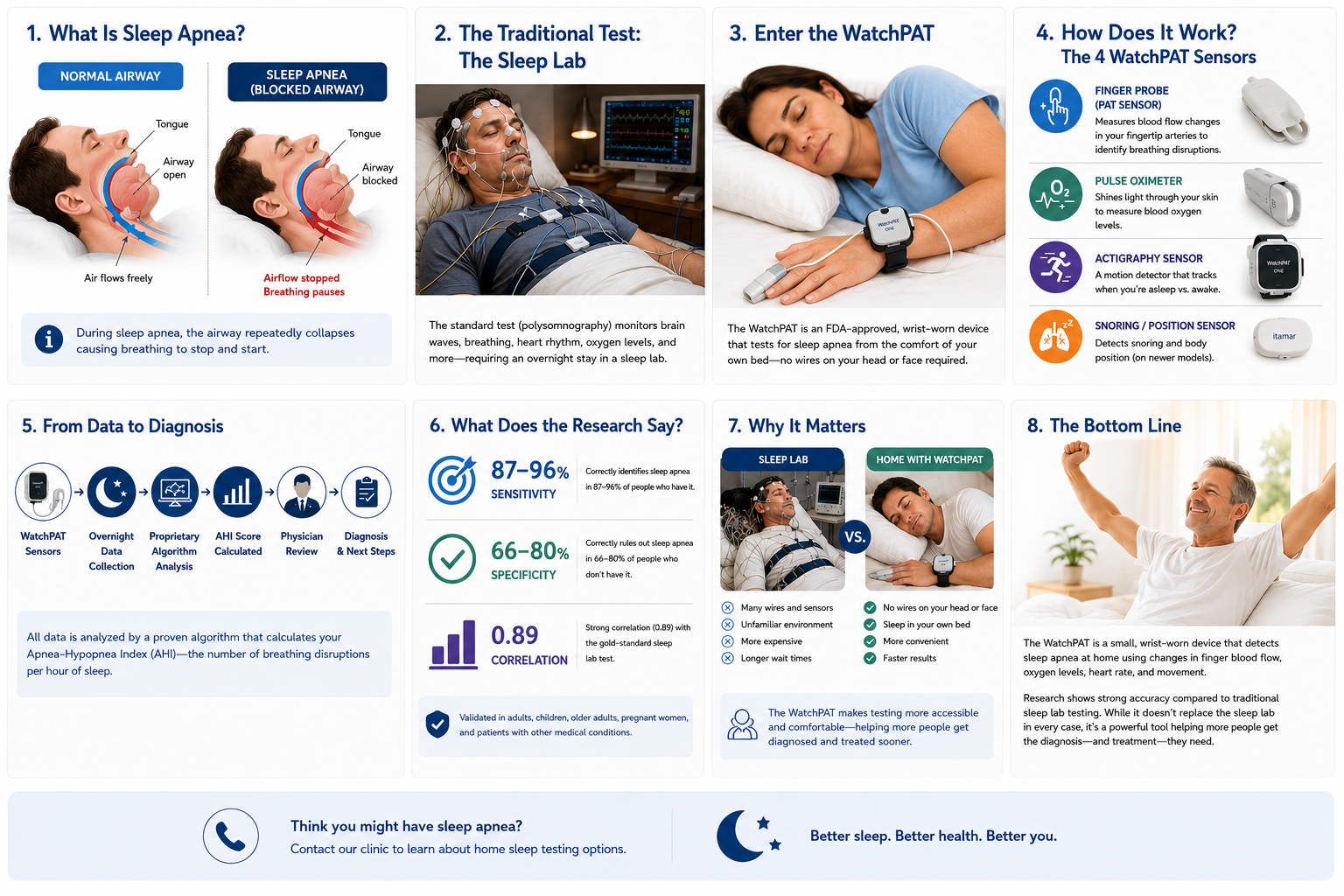
Sleep apnea is a condition where your breathing repeatedly stops and starts while you sleep. It happens when the muscles in the back of your throat relax too much and temporarily block your airway — sometimes hundreds of times per night without you knowing it. Left untreated, it can lead to daytime sleepiness, high blood pressure, heart disease, and other serious problems. The good news? Once diagnosed, it's very treatable.
The Traditional Test: The Sleep Lab
The standard way to diagnose sleep apnea is an overnight stay in a sleep laboratory for a test called polysomnography (PSG). Technicians attach sensors all over your body to monitor brain waves, breathing, heart rhythm, oxygen levels, and more. While PSG is extremely thorough, it means sleeping in an unfamiliar place, it can be expensive, and wait times are often long.
Enter the WatchPAT
The WatchPAT is an FDA-approved, wrist-worn device that tests for sleep apnea from the comfort of your own bed. Think of it as a high-tech wristwatch you wear for one night — no wires on your head or face required.
How Does It Work?
Finger Probe (PAT Sensor)
Pulse Oximeter
Actigraphy Sensor
Snoring/Position Sensor
Every time your airway gets blocked during sleep, your body has a mini "fight or flight" response — your heart rate changes and the blood vessels in your fingertips tighten. These changes are tiny, but the WatchPAT detects them using a technology called Peripheral Arterial Tonometry (PAT).
The device has four key sensors:
Finger probe (PAT sensor): Measures blood flow changes in your fingertip arteries to identify breathing disruptions.
Pulse oximeter: Shines light through your skin to measure blood oxygen levels — which drop when you stop breathing.
Actigraphy sensor: A motion detector in the wrist unit that tracks when you're asleep vs. awake.
Snoring/position sensor: Detects snoring and body position (on newer models).
WatchPAT Sensors → Overnight Data Collection → Proprietary Algorithm → AHI Score → Physician Review → Diagnosis
All this data is fed into a computer algorithm that calculates your Apnea-Hypopnea Index (AHI) — a score that tells your doctor how many times per hour your breathing was interrupted.
What Does the Research Say?
87–96% Sensitivity
66–80% Specificity
0.89 Correlation with Sleep Lab Testing
Multiple studies have compared the WatchPAT to the gold-standard sleep lab test:
Strong accuracy: A meta-analysis of 14 studies (909 patients) found WatchPAT scores correlated highly with sleep lab results — 0.89 out of a perfect 1.0.
High sensitivity: A review of 18 studies found the WatchPAT correctly identified sleep apnea in 87–96% of people who had it.
Good specificity: The same review showed it correctly ruled out sleep apnea in 66–80% of people who didn't have it.
Validated broadly: Tested in adults, children, older adults, pregnant women, and patients with other medical conditions.
Consistent results: Studies show that taking the test twice produces very similar scores.
Limitations to Know
Negative test results may require follow-up
Certain heart rhythm disorders
Arterial disease
Need for in-lab testing in some patients
Works best in people with a moderate to high likelihood of sleep apnea. A negative result may still require a follow-up sleep lab study.
Conditions like stiff arteries or irregular heart rhythms may affect accuracy.
The American Academy of Sleep Medicine recommends an in-lab study if a home test is negative or inconclusive.
Why It Matters
Sleep apnea is massively underdiagnosed. The WatchPAT lowers the barrier to testing by making it more accessible, comfortable, and convenient — helping more people get diagnosed and treated sooner, improving their sleep, energy, heart health, and quality of life.
The Bottom Line
The WatchPAT is a small, wrist-worn device that detects sleep apnea at home using changes in finger blood flow, oxygen levels, heart rate, and movement. Research shows strong accuracy compared to traditional sleep lab testing. While it doesn't replace the sleep lab in every case, it's a powerful tool helping more people get the diagnosis — and treatment — they need.
If you think you might have sleep apnea, reach out to Remedy Sleep & Wellness to learn about convenient home sleep testing options.